
ABOUT MMI
ABOUT MMI

The History of Mboho Mkparawa Ibibio (MMI) - London Chapter.
Mboho Mkparawa Ibibio (MMI), was founded on 1st August 1987 by a small group of Ibibio indigenes to preserve the Ibibio heritage and to promote the economic, social and political empowerment of all Ibibio sons and daughters. The expansion of chapters all over Nigeria did not begin until 2001 under the presidency of Akparawa (Prince) Godwin Ude.
In early 2001, Akparawa Uko Obot, a London resident, was on a private visit to Akwa Ibom State and was introduced to the MMI Exco in one of its meetings by the then President 3 – Aparawa Okon Imeh. Akparawa Uko Obot was inspired by the deliberations, touching on core values of Ibibio interests, so at the end of the meeting Akparawa Uko Obot sought permission from the current MMI Exco to introduce the concept of MMI to the Ibibio indigenes resident in London. This request was of interest to the MMI Exco as there had never been MMI chapter in the diaspora, and Akparawa Uko Obot was then asked to put this request into writing for consideration.
On 6th of April 2001, Akparawa Uko Obot applied for permission to start London chapter. On 10th of April 2001, the MMI Central working committee (CWC) replied and provisionally granted permission to run the London chapter of MMI with Akparawa Uko Obot as the nominated Co-ordinator. His vision had a positive impact on the development of MMI in the diaspora. Messages were sent out to Ibibio indigenes to visit his residence for a meeting about their ethnic group. Those who attended were not sure about what to expect, but when the social- cultural organisation messages of MMI was proclaimed those who understood the message got registered. On the subsequent meetings even more people turned up and the news about MMI was further echoed. To encourage membership participation, copies of the MMI constitution was distributed and members were informed about the objectives of MMI while dues, levies and other payments were also made known.
To get organised and to promote MMI, it was expedient to have leaders among the group, hence the need for an election of members into executive positions was conducted after six meetings (as stipulated by the Permission letter). Under the MMI constitution, the International President inaugurates a chapter and inducts members into MMI. Therefore, members were elected on a ‘pro-tem’ basis to allow the running of the chapter affairs, pending when the international president could visit London for the chapter inauguration and members induction. In the meantime, Akparawa Jimaima Essien, a long standing MMI member and former Eket chapter chairman who was residing in Manchester was nominated by the Central Working Committee to support the new London chapter by providing advice and overseeing their activities for development and growth.
Regular monthly meetings were held on a rotational basis at the residence of the members, and on the 9th of March 2002 the first election of officers was held at a member’s residence in Hampton Hill, Middlesex, UK. There were 17 pioneer members present and the following were the first elected EXCO officers:
- Uko Obot Chairman
- Etebom Jacob Secretary
- Okokon Ekanem Vice -chairman
- Aniefiok Ekanem Publicity secretary
- Ubong Edem Financial secretary
- Jenny U. Obot Treasurer
- Catherine Eno Welfare Officer
- Aniefonama Jacob Organising secretary
- Ima Umanah Women Leader
- Nse Umoh Provost
- Akan Nkweini Auditor
Anthem
Abasi ibededem esed
Unwam k’ini iso
Itie Udibe nnyin k’uwem
Nsinsi idun nnyin
O God our help in ages past
Our hope for years to come
Our shelter from the stormy blast
And our eternal home.
Mboho Mkpararwa Ibibio uniform.

MMI’s official uniform is a distinctive attire which proudly reflects the Ibibio traditional wear.
In June 2013, MMI London chapter was instrumental to the design and commission of the current wrapper worn as part of Mboho mkparawa ibibio’s official uniform.
The Formal uniform for men is as follows:
- Red george wrapper with MMI logo and inscriptions in gold (traditional usobo)
- White Chieftaincy shirt with a long tail and elbow length sleeves.
- Traditional knitted cap with the inscription ‘MMI’.
The Formal uniform for women is as follows:
- White short sleeves blouse.
- Red george complete 2- wrapper (ndot iba), with MMI logo and inscriptions in gold.
- Red head tie with the inscription ‘MMI’.
Mboho mkparawa Ibibio London chapter’s profile in the last 20 years
UNDER CONSTRUCTION!
ORIGIN OF IBIBIO PEOPLE

– By Archibong Eyo
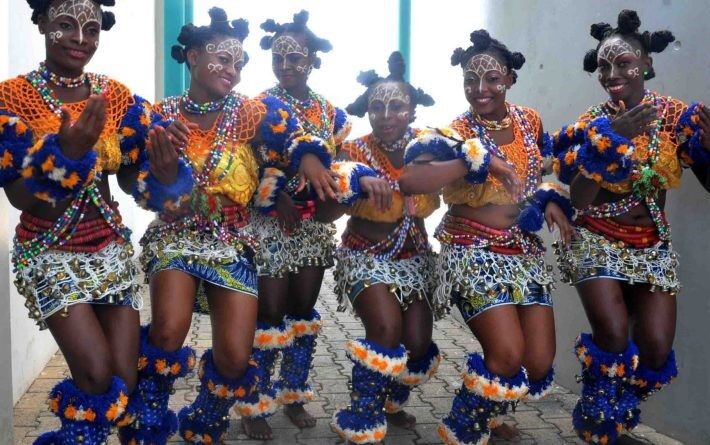
The Ibibio people are a coastal people in southern Nigeria. They are mostly found in Akwa Ibom, Cross River, and in the Eastern Part of Abia State. The Ibibio are the 4th largest ethnic group in Nigeria. The Ibibio language is probably one of the mother languages of the ancient proto-Bantu nation.
They are related to the Annang, Eket, Oron, Igbo, Efik and a cluster of some notable ethnic factions. During the colonial era in Nigeria, the Ibibio Union envisaged the need to unite as one nation thus the request for recognition by the British as a sovereign nation (Noah, 1988). The Annang, Efik, Eket, Oron and Ibeno and many others do share personal names, culture, cuisine, and traditions with the Ibibio, and speak closely related (dialects) of Ibibio which are more or less mutually intelligible.
As observed by G.I. Jones and Darryl Ford the word Ibibio is both an ethnic and a linguistic term. All the Ibibio people speak and understand the Ibibio language. The dialectal differences among the various Ibibio groups can be attributed largely to the long period of territorial isolation over a long period of time. Linguistic homogeneity decreases with the rise in population and with the expansion of the occupied area. With reduced interaction, the speakers of Ibibio tend to form variants of their language.
ORIGIN
As the saying goes that, a people without the knowledge of their past history, origin and culture is like a tree without roots.
It was imperative that I draft an open memoir on the origin of the Ibibio nation since only a handful of text was available. Secondly, I longed to create an enabling environment that promotes enlightenment, debates and discussions on our heritage.
It follows that early records of Ibibio history were documented by the British colonial administrators and anthropologists. In their thesis, they vividly described various plausibility that best describes the origin of the Ibibio as we shall consider below.
The Ibibio origin is highly speculative and varied. They are speculated to be amongst the earliest inhabitants of Nigeria. It is estimated that they arrived at their present home around 7000 B.C. In spite of the historical account, it is not clear when the Ibibio arrived to their current location. According to some scholars, they might have hailed from the central Benue valley; east of the River Niger, as they share cultural affinity with the ancient Jukun people.
Another seeming factor is the wide-spread use of the manila, a popular currency used by the Jukun during their subsequent southern drive towards the littoral, South-south of Akwa Ibom State.
Other available traditional sources suggest that the earliest stock of the Ibibio is the Afaha clan who ancestral home is claimed to be Usak Edet (Isangele, Isanguele) in South Western Cameroon. According to (Ford and Jones), the Ibibio settlement of Isangele remnants (The Bakoko people) now forms a small tribe in the Ndian department who share strong cultural affinity with the Ibibio. (Noah, 1980a).
In pursuance of the hypothesis, field workers who frequented this part of the country speculatively attested to a similar school of thought that the core Ibibio people hail from Afaha lineage; whose original home is Usak Edet or “Edet Afaha” (Afaha’s Creek) as fondly ascribed by the Ibibio. Before long, upon emigrating Cameroon, the Ibibio arrived at their present location following two major directions. One major group reached Nigeria by an overland route and settled at Ibom in Arochukwu. Here, they erected a shrine dedicated to the worship of the famous Ibritam or Ibin okpabi (long juju) god. Some sources, however, point that they actually arrive in observance of their host worshiping the said god. This form of adoration however did stir resentment amongst the Ibibio which resulted in conflict and their eventual expulsion from Aro Dynasty.
Some sources point out that religious and social rifts between the host and their arrivals widened as the latter celebrated (Ndok) festivity hence the provocation and subsequent expulsion from Ibom. The aftermath was the Ibibio emigrating to Abak, Uyo, Ikot Ekpene, Itu and part of Cross River. While the second group of Ibibios set ashore via sea, which constitutes Uruan, Oron, Eket, and Ibeno people.
The split of the sub-group (now called the Efik) from their kinfolk the (Uruan), seem to have commence around the sixteenth century. After an exit from Ikoneto, the greater part advanced to Mbiabo and Adiabo and while others to Creek Town. Talbot, who for many years conducted anthropological research among the Ibibio, suggested that the Efik started to claim a separate identity by about 1600 AD.
The final settlement of the Efik, according to some sources seems to have occurred in 1670. At about this time some of the Efik chiefs from Creek Town who were cut off from their kin at Obutong by European traders, moved to a new site now called Duke Town. This is about four kilometers south of 0butong, at a strategic location just across the anchorage of the European trading ships.
OPPOSITION TO THE THEORY
Jeffreys (1927) in his publication contradicted the hypothesis that the Ibibio had migrated from far-off-lands in Africa to their present homelands. Adding that there are no legends nor tradition to support this theory. He postulated that they must have settled the Forest belt for centuries to have forgotten their history. The migratory assumption has become a subject of debate amongst Ibibio intellects, however speculative and varied it may recur.
As earlier mentioned, Traditional sources suggest that the earliest family of the Ibibio which constitutes the Afaha clan ancestral home is Usak Edet (Isangele) in South-western Cameroon. The theory is in addition, supported by substantial similarities between the Ibibio and the former (bakoko people of southern Cameroon) as stated by Noah, (1980.
It was further suggested that the Ibibio people migrated from the eastern axis of their current homeland in two major directions. One group may have arrived at the Ibibio Mainland by an overland route and settled at Ibom in Arochukwu formerly an Ibibio territory (Noah 1980b).
This was supported by Jeffreys (1927) who states that Ibibio lived in Arochukwu probably between A.D. 1300 and 1400 and for a long time maintained a famous shrine called Long Juju of Arochukwu (Ibritam).
But this latter suggestion is discounted by Aye as he postulated that the Ibibio have no such tradition nor practice of such a cult. Meanwhile, most scholars continue to sustain the theory of Ibom in Arochukwu as the cradle of Ibibio expansion.
It is thought that the people of present-day Abak, Uyo and Ikot Ekpene who are described as Eastern Ibibio or Ibibio proper might have migrated from that part of the country, although as we shall see later, the structural layout of their clans today barely supports this viewpoint.
The migration pattern of the Ibibio from the south-western highlands of Cameroon to the Lower Cross River Basin is assumed by most scholars to have occurred in two phases.
The first passages are natural ravine namely the Benue and Mamfe. Troughs while the second is via Niger-Benue credited for being a domain of great historical and cultural melting pot of the proto-bantu people.
The geological history of the south-eastern lowlands however shows that only the Oban Massifs and Adamawa Highlands stood above the sea. during those periods. This suggests that the Lower Cross River basin might have remained under the sea for ‘a long time’ (Dessau and Whiteman, (1972).
Coupled with a dense forest which at its primeval era would have been a very difficult terrain to surmount. In other respects, as the Ibibio migrated from Ibom and adjusted to their riverine environment, the Cross River and its numerous tributaries would have certainly posed a formidable barrier some suggest.
Another school of thought assert that the Ikono Centre of Dispersion Hypothesis is key to understanding the origin of the Ibibio nation. It speculates that the cradle of the Ibibio people lies somewhere between the Abak and Uyo axis of Akwa Ibom State.
How about the “Ibom center” hypothesis? A theory that suggests a migratory pattern (resembling a fan or beam from a torchlight) as opposed to a fan-like shape layout of clans as some Ibibio scholars might have assumed? Peradventure, the “Ikono center theory”, which suggests that the Ibibios might occupied this stretch of land for centuries thus, no basis to support the Ibom and Isanguele hypothesis. It suggests a settlement resembling a diffusion of pattern in ripples, which mimics a stone dropped into a pond or the spokes of a wheel.
The Ikono center theory findings demonstrate that at least sixteen major clans are speculating to have evolved from a common epicenter namely Ikono. It further embodies a perfect shape which significantly incorporates sub-clan from the western, eastern, northern, and southern stock.
In conclusion, it is apparent to reckon that the narrative in this sense is inconclusive. Thus, I would admonish that the appropriate office in Akwa Ibom State take charge to sponsor, promote and support initiatives geared towards acquisition of knowledge in this domain. It could be achieved by setting up a committee in charge of drafting, conducting and publication of works devoted on our heritage.
It is recommended that this publication be distributed to all educational institutions in the state both in hard and soft copy.
BBC News Igbo
Igbo history.TV
Membership Admission Process
Membership of Mboho Mkparawa Ibibio is voluntary and open to sons and daughters of Ibibio. However, honorary membership status is usually conferred on non-Ibibios of proven integrity.
A full member of Mboho Mkparawa Ibibio is addressed as Akparawa (for men) and Akparawa-awan (for women). To become a full member of Mboho Mkparawa Ibibio, an applicant must go through a formal application and Induction.
An applicant can obtain a Membership Registration Form from the National Secretariat via an identified chapter of his or her choice. Upon submission of an application form with the prescribed non-refundable fee, the intending member is granted observer status and is expected to attend a minimum of 3 consecutive meetings which would form part of the applicant’s probation period. During this time, investigations are carried out on the applicant’s place of work, residence and village. After satisfactory attestation by the Membership Committee, a provisional membership is approved for the applicant subject to formal induction by the MMI International President.